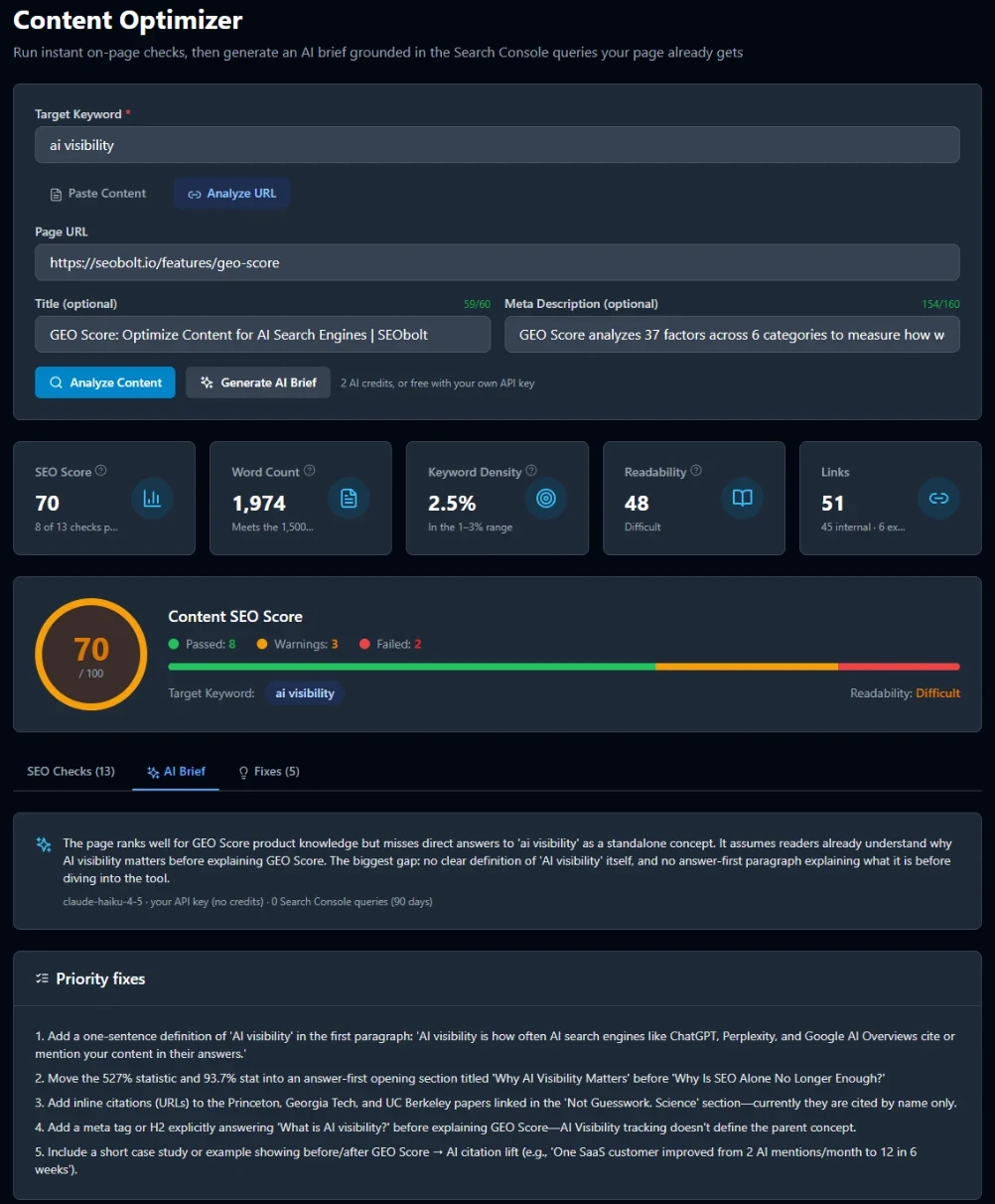
The AI content optimization tool that uses your real Google Search Console data to deliver smarter SEO suggestions. Optimize for Google rankings and AI search citations simultaneously.
Most SEO content optimizers rely on scraping competitor pages and guessing what Google wants. SEObolt takes a fundamentally different approach: it uses your actual Search Console data to understand what's already working and what needs improvement.
By analyzing your real impressions, clicks, and average position data alongside AI-powered NLP analysis, SEObolt generates recommendations that are grounded in performance data — not just competitor copying. For example, if a page gets 5,000 impressions for a query but ranks at position 12, the optimizer flags it as a high-priority candidate where minor content tweaks can unlock page-one traffic.
Link your Google Search Console for real performance data
Choose a page to analyze and optimize
Get AI-powered suggestions based on real data
Apply changes and track ranking improvements
In 2026, ranking on Google isn't enough. Your content also needs to be cited by ChatGPT, Claude, Perplexity, Gemini, and DeepSeek. SEObolt's content optimization tool for AI search checks for both in one pass.
Generative Engine Optimization (GEO) and Answer Engine Optimization (AEO) aren't separate disciplines — they're extensions of great SEO. Content that's well-structured, authoritative, and comprehensive ranks well on Google AND gets cited by AI. SEObolt's optimizer helps you achieve both with a single workflow. In our experience, pages that score well on both traditional SEO and AI-readability metrics see the most sustainable traffic growth over time.
“The best practices for SEO remain relevant for AI features in Google Search (such as AI Overviews and AI Mode). There are no additional requirements to appear in AI Overviews or AI Mode, nor other special optimizations necessary.”
— Google Search Central, Official Google documentation · AI features and your website
Every piece of content gets a comprehensive on-page SEO score with specific, actionable recommendations to improve it.
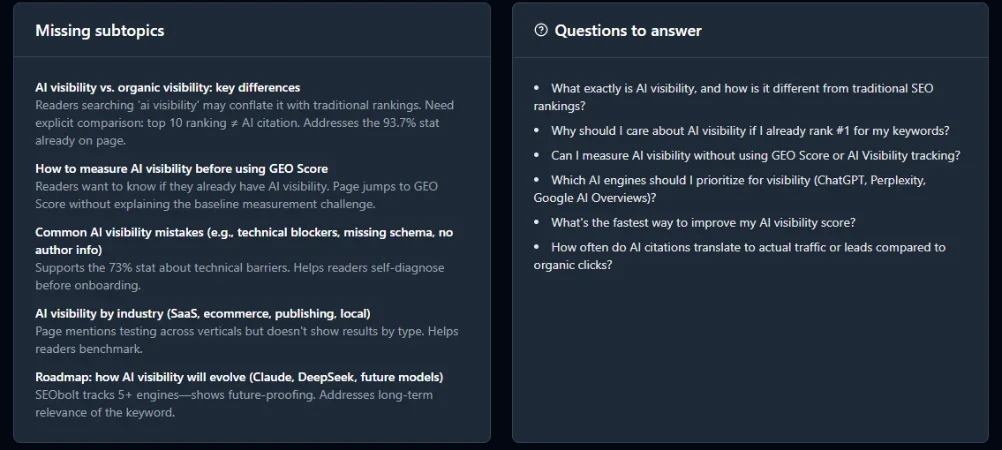
AI-identified keywords you should target based on your Search Console data and content gaps. Not guesswork — real data.
A 0–100 score from 13 on-page checks — keyword placement, length, headings, readability, paragraphs, links, title and meta — each with a specific fix.
Heading hierarchy analysis with suggestions for H2/H3 topics that cover the subject comprehensively for users and search engines.
A length check against a 1,500-word target for competitive topics, plus an AI-suggested outline showing which sections to add — so extra words go where the demand is, not into padding.
Counts internal and external links (links to your own domain count as internal) and flags pages with too few, so every page connects into your site's topical structure.
Flesch-Kincaid scoring with plain language suggestions. Content that's easy to read ranks better and gets cited more by AI.
Here's what makes SEObolt's AI SEO writing assistant different from Surfer, Clearscope, or Frase: we use your actual Google Search Console data.
Other tools scrape SERPs and build keyword lists from third-party databases. SEObolt shows you the exact queries driving impressions and clicks to your pages, then cross-references that with AI analysis to find optimization opportunities. When Ahrefs checked third-party volumes against Search Console impressions, even its own estimates were roughly accurate in only 60% of cases, versus 45% for Google Keyword Planner (Ahrefs).
“Search Console tools and reports help you measure your site's Search traffic and performance, fix issues, and make your site shine in Google Search results.”
— Google Search Console, Official Google product page · Google Search Console
AI-powered content optimization delivers different value depending on the team using it. These four workflows are where SEObolt's GSC-grounded approach outperforms competitor-scraping alternatives most clearly.
Most content libraries have a meaningful share of underperforming pages that rank in the 8-to-20 range with declining impressions. Rather than researching brand-new topics, the highest-ROI move is refreshing those existing pages. SEObolt's AI Content Optimizer pulls the actual queries each page appears for from Google Search Console, identifies gaps between those queries and the page content, and generates specific refresh recommendations. Refreshed pages tend to move up faster than net-new content because Google already recognizes the URL.
2026 content needs to work on Google organic AND get cited by ChatGPT, Claude, and Perplexity. The signals differ: Google rewards depth and keyword coverage; AI engines reward answer-first structure, inline citations, and named-entity density. SEObolt scores content for both surfaces in a single pass and generates recommendations tuned to whichever surface a page under-performs on — usually the AI side, since most published content was never optimized for it.
Agencies producing dozens of content briefs per month need a repeatable process. The AI Content Optimizer generates structured briefs with target keyword clusters, recommended headings, entity coverage, competitive-length benchmarks, and answer-first templates — then re-scores the drafted content before publication. Manual brief-building work compresses substantially without losing the strategic depth clients pay for.
Comparison pages ("[competitor] alternative," "[category] pricing") are among the highest-converting SEO surfaces for SaaS. They also need the most careful optimization: keyword coverage, competitive-feature parity, AI-answer eligibility, and schema markup all matter. SEObolt scores every draft against the queries you actually appear for, so comparison pages get published with the right signals from day one instead of needing repeated post-launch iterations to rank.
The AI Content Optimizer is a recommendation engine, not a copywriter. Following these six practices ensures the recommendations translate directly into ranking gains instead of noise.
AI briefs run on Anthropic's Claude Haiku 4.5 or OpenAI's GPT-4o-mini. With BYOK (Bring Your Own Key), connect your own Anthropic or OpenAI key and the brief runs on it — you pay the provider directly at cost, with no SEObolt credits used. Without your own key, a brief uses 2 AI credits from your plan.
Yes for the AI brief — it is written in your page's language and reads your Search Console queries in any language, including Spanish, German, French, Portuguese, Japanese, Korean, and Chinese. The readability score uses the English Flesch formula, so treat it as a rough guide on non-English pages.
Ask ChatGPT to optimize a page and it will invent recommendations that sound plausible but are not grounded in your actual search performance. SEObolt starts with your real GSC data — the queries you appear for, the pages you rank on, the impressions you actually get — and only then applies AI reasoning. Recommendations are grounded in fact, not hallucination.
The optimizer generates structured recommendations, briefs, and outlines but stops short of writing final copy. This is intentional: AI-generated body copy currently underperforms human-written copy in both AI-answer citation rates and Google organic rankings. SEObolt gives your writers the strategic map; the writing craft still comes from your team.
No. Google's guidance is clear: it does not penalize AI-assisted content workflows; it penalizes low-quality, unhelpful content regardless of how it was produced. SEObolt's optimizer generates recommendations to improve quality, structure, and coverage — not to spin low-effort AI copy. Used as designed, it improves your Helpful Content Update signals rather than hurting them.
Connect your Search Console and get AI-powered suggestions in minutes.
Get Started