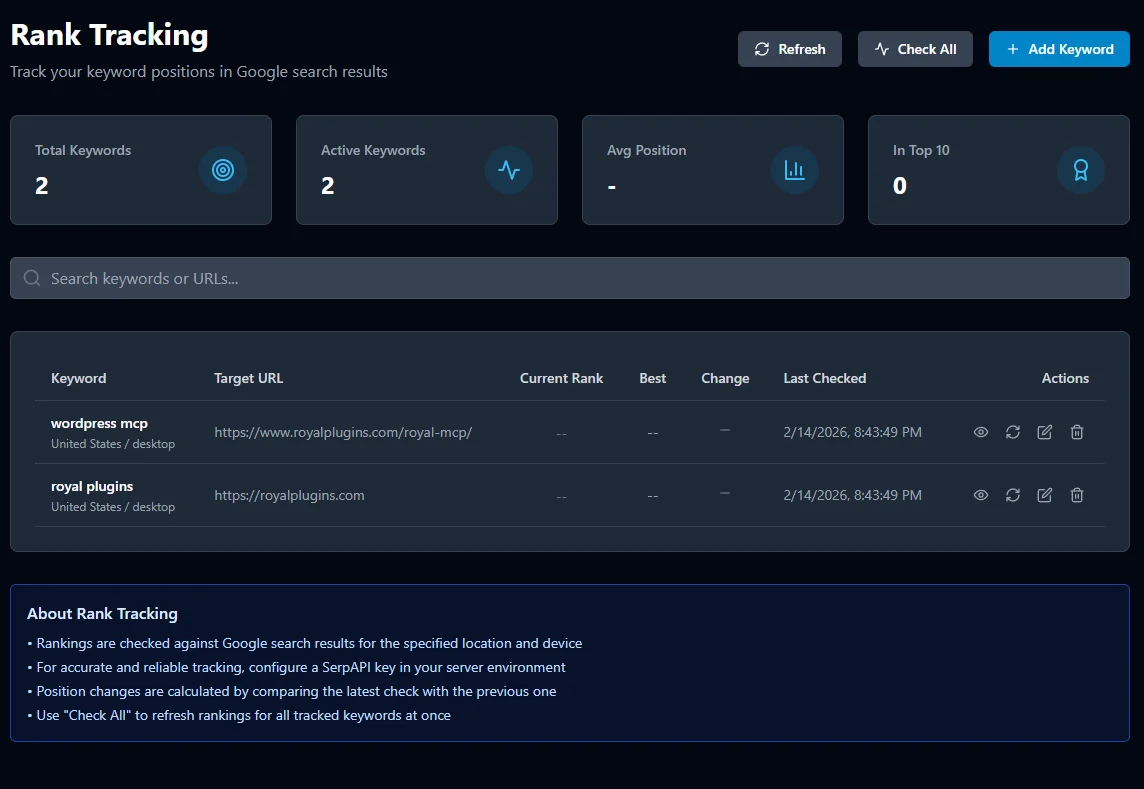
A keyword rank tracker that monitors your positions on Google AND your visibility across AI search engines like ChatGPT, Claude, Perplexity, Gemini, and DeepSeek — all in one dashboard.
SEObolt's Google rank tracker tool delivers reliable, daily position updates for all your target keywords. Know exactly where you stand in search results every morning. We built this on top of real Google Search Console data rather than scraped SERP results, so the positions you see reflect what Google actually reports.
SEObolt tracks Google AND AI search engines in one SERP position tracker, on every plan — no add-on needed. See the complete picture of your search visibility.
“We actually look at AI Overview data every day—especially for important prompts our clients care about—and track how often they’re being cited in those responses.”
— Lily Ray, Vice President, SEO Strategy & Research, Amsive · How Publishers Can Survive (and Thrive) in the Age of AI Search (The Search Session, Advanced Web Ranking)
| Feature | Traditional Rank Trackers | SEObolt |
|---|---|---|
| Google SERP positions | ✓ | ✓ |
| Desktop & mobile tracking | ✓ | ✓ |
| Competitor comparison | ✓ | ✓ |
| ChatGPT brand mentions | — | ✓ |
| Claude visibility | — | ✓ |
| Perplexity citations | — | ✓ |
| AI share of voice | — | ✓ |
| Real GSC data (not estimated) | — | ✓ |
Dive deeper with the AI Visibility feature to see exactly how each AI platform mentions your brand.
Know where you stand against your competition. SEObolt's rank tracker lets you add competitor domains and see side-by-side ranking comparisons for every tracked keyword. Most users discover meaningful gaps where competitors outrank them but where a small content update could close the gap.
Side-by-side position comparison. See who ranks higher for each keyword at a glance. Filter by position range, trend direction, or SERP features.
Discover keywords your competitors rank for that you're missing. Prioritized by search volume and difficulty for maximum impact.
Modern SERPs are more than just 10 blue links. Track your presence across every SERP feature and monitor your overall search visibility trends over time. Pew Research Center found 18% of Google searches in March 2025 generated an AI summary, making AI Overviews a SERP feature worth tracking separately from classic rankings (Pew Research Center).
“AI Overviews are only shown when our systems determine that it is additive to classic Search, and as such, often don't trigger.”
— Google Search Central, Official documentation, Google · AI features and your website
Daily rank tracking is a diagnostic tool, not a vanity metric. These four use cases are where teams get direct ROI from watching positions change every 24 hours.
Content teams need to prove that every piece of published content moves rankings. Daily rank tracking maps position gains directly to publish dates, so you can attribute traffic wins to specific content investments. Instead of quarterly "what happened" reports, you get weekly cause-and-effect visibility: which topics ranked, which optimizations moved the needle, which content missed and why. That is the difference between defending content budget and growing it.
Product-category rankings shift dramatically around Black Friday, Christmas, back-to-school, and Q4 in general. Daily tracking catches ranking drops in real time so you can respond — refreshed meta, updated schema, new supporting content — before the peak sales window closes. Slipping several positions on a high-intent category page during peak season can cost significant revenue that daily tracking helps you catch and reverse in time.
Every agency needs client-facing rank reports, and clients evaluate agency performance on ranking gains they can see. SEObolt's daily updates and white-label report export mean agency dashboards always show current data, and client reports pull straight from real GSC-backed positions rather than estimated third-party data that clients then dispute. Trust in the numbers means longer retainers.
Category-defining keywords ("best CRM software," "email marketing platform") see position volatility every week as competitors publish comparison pages, land backlinks, and update landing pages. SEObolt tracks Google positions and AI Overview citation ownership together, so a SaaS team sees who owns the category term across both traditional search and AI-answer boxes — the two surfaces where category buying research now happens. Competitor comparison is available on the Agency plan.
Tracking every keyword you have ever ranked for is noise, not signal. These six practices focus rank tracking on the decisions it can actually inform.
SEObolt uses your verified Google Search Console properties as the primary data source for organic position tracking. GSC reports the actual average position Google served your URL at for each query — the ground truth, not a scrape. For competitor domains you do not own, SEObolt uses a combination of live SERP snapshots and inference from public GSC data, both of which respect Google's rate limits and Terms of Service.
Yes. Google returns different SERP layouts and often different positions for mobile vs. desktop for the same query. SEObolt tracks both separately so you can see, for example, that you rank position 3 on desktop but position 8 on mobile for a commercial-intent keyword — a diagnostic that leads straight to mobile page speed, mobile UX, or mobile-specific schema fixes.
Yes. SEObolt supports geo-specific tracking down to city and country level for any keyword. Set the location per project or per keyword — useful for multi-location SEO teams managing franchise or dealer networks that need per-market visibility.
GSC positions are what Google actually served, weighted by real impressions from real searchers. Scraped SERP data is a snapshot of what Google would serve to a bot in one geographic location at one moment — useful for competitor visibility but a poor proxy for your own site's performance. GSC-based tracking eliminates the volatility caused by SERP snapshot timing and personalization noise.
SEObolt's SaaS plans include AI Visibility keywords (for AI search visibility) as follows: Growth ($29/mo) tracks 10, Scale ($79/mo) tracks 50, and Agency ($199/mo) tracks 200 — every one with daily position updates, historical trends, and SERP feature monitoring at no extra cost. GSC-backed Google rank tracking is included at generous limits on every tier, and you never pay per-lookup the way SEMrush and Ahrefs charge for their higher-frequency tiers.
How to pick keywords, read rank movements, and act on position drops before they cost you traffic.
Improve the underlying signals that move rankings: content quality, schema, and technical SEO factors scored head-to-head.
Connect your Search Console and see your keyword positions in minutes.
Start Tracking