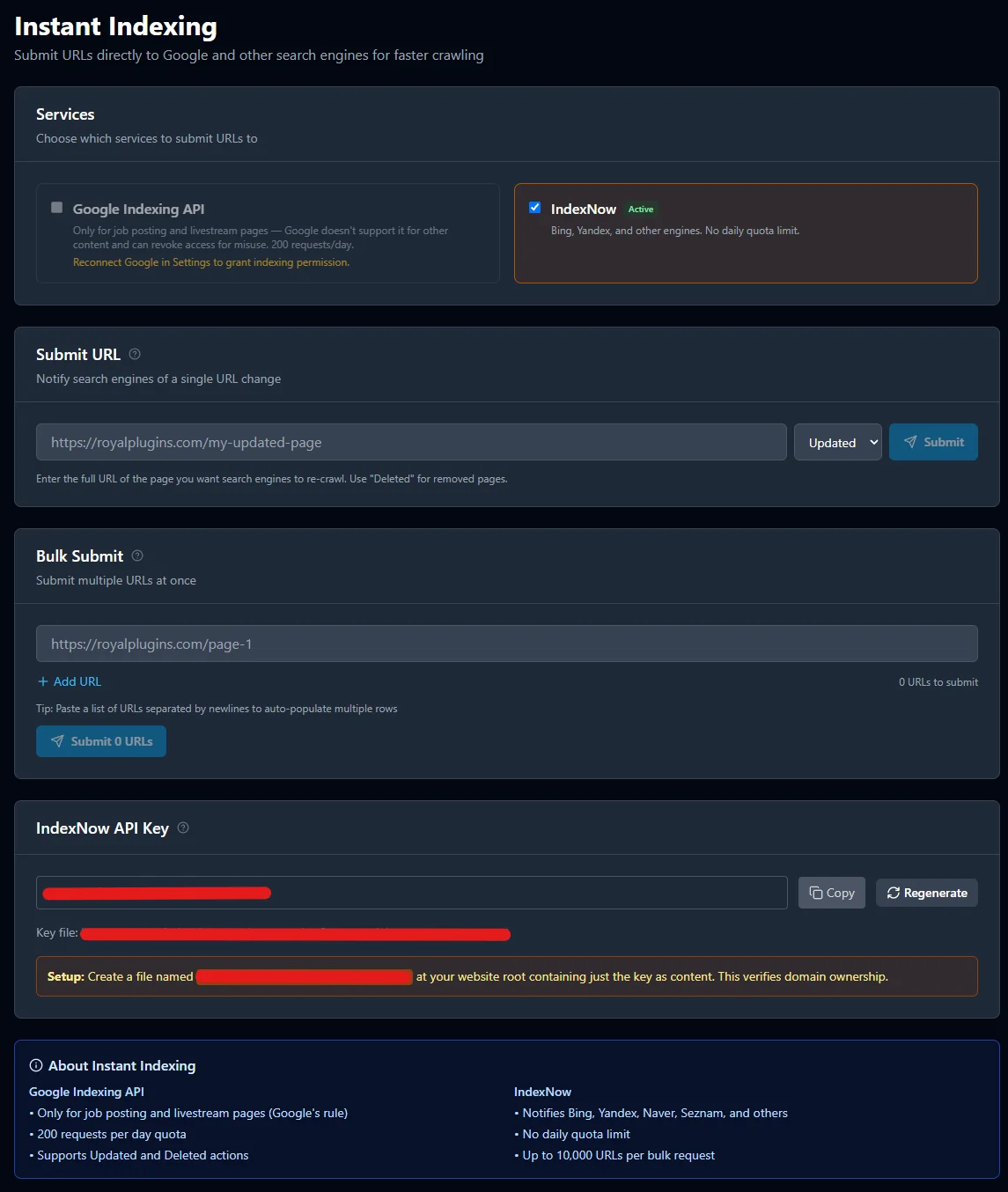
Don't wait weeks for search engines to stumble on your new pages. SEObolt pings Bing, Yandex, Naver and Seznam the moment you publish through IndexNow, and submits your sitemaps to Google Search Console so Google finds new URLs on its next sitemap read. For job postings and livestreams, it can also use Google's Indexing API, the only pages Google supports it for.
IndexNow covers Bing, Yandex, Naver and Seznam with one ping. Google doesn't use IndexNow, so SEObolt keeps your sitemaps submitted in Search Console, and uses Google's Indexing API only where Google allows it.
Sitemaps submitted to Search Console with the same OAuth your Rank Tracking uses. Google's Indexing API is available for job posting and livestream pages, the only content Google supports it for.
Bing was IndexNow's original sponsor. An IndexNow ping tells Bing about a new or changed URL right away, instead of waiting for it to be found by crawling.
IndexNow is a shared protocol: submitting once notifies every participating engine, including Yandex. Free coverage for international SEO.
IndexNow uses a simple verification pattern: each site hosts a small .txt file at the site root containing its key, and submissions reference that key so the search engine can confirm you control the domain. SEObolt makes the setup a single click: Generate IndexNow Key. It gives you the exact filename.txt and contents to deploy at your site root.
Once the key is in place, submissions go out cleanly to all participating engines. If a key is ever cleared (database restore, manual reset), the UI shows an empty state with a regenerate prompt rather than letting submissions silently fall over. You'll always know whether the channel is live.
filename.txt and contents you drop at site rootXML sitemaps tell search engines about your entire site. Instant indexing tells them about specific URLs that just changed. Use sitemaps as the steady-state crawl signal, then trigger instant submissions when something specific needs fast attention: new blog posts, price changes on product pages, urgent corrections to a story. Most sites need both, not one or the other.
IndexNow notifies Bing, Yandex, Naver and Seznam within seconds of submission. Google doesn't support IndexNow, so for Google SEObolt submits your sitemap to Search Console and Google re-reads it on its own schedule. How fast a page is actually indexed is always up to each search engine, not SEObolt.
Google's Indexing API is an official endpoint for telling Google about new or removed URLs, but Google only supports it for pages with JobPosting or BroadcastEvent (livestream) markup, and it runs spam detection on every submission. IndexNow is an open standard adopted by Bing, Yandex, Seznam and Naver: one ping notifies all of them. For regular pages, SEObolt uses IndexNow for those engines and submits your sitemap to Google Search Console.
Yes. IndexNow requires a per-property key hosted at the root of each domain. SEObolt generates and manages the key file automatically for each property you connect, verifies it is reachable, and warns you if the file returns a 404. Manual IndexNow setups commonly fail silently because the key file is missing or unreadable; SEObolt's per-property key handling prevents that.
No, instant indexing complements your sitemap, it does not replace it. Sitemaps give search engines a complete map of every URL on your site for periodic crawl scheduling. Instant indexing pushes new and updated URLs to the front of the queue so time-sensitive content (news, product updates, events) gets crawled immediately instead of waiting for the next sitemap cycle. Use both together for full coverage.
Only for the pages Google supports it for. Google's documentation says the Indexing API can only be used for pages with JobPosting or BroadcastEvent embedded in a VideoObject, and that submissions go through spam detection; abuse can get API access revoked. Use it for job postings and livestreams only. For everything else, submit your sitemap in Search Console (SEObolt does this for you) and use IndexNow for Bing and the other engines.
“The Indexing API can only be used to crawl pages with either JobPosting or BroadcastEvent embedded in a VideoObject.”
— Google Search Central documentation · Indexing API Quickstart
IndexNow accepts up to 10,000 URLs per request and doesn't publish a hard daily cap, though engines rate-limit abusive volume. Google's Indexing API defaults to 200 URLs a day per project, for eligible job posting and livestream pages only. Sitemaps have no submission quota.
Yes. Instant indexing prompts a crawl, but crawlability depends on your page being reachable and indexable. For JavaScript-heavy sites (React, Vue, Next.js SSR-off), make sure your critical content is server-rendered or pre-rendered before submitting. Submitting a client-side-rendered URL still works, but Google's separate rendering step can add additional delay after the initial crawl.
No. Submitted URLs must be publicly reachable by Googlebot and Bingbot. A URL behind HTTP basic auth, a staging password prompt, or a login wall will be rejected on crawl attempt. Verify with a fresh incognito browser session before submitting.
Any site that publishes time-sensitive content loses traffic while new URLs wait to be discovered. Instant indexing shortens that wait on the engines that support it, and keeps Google's sitemap current, for these workflows.
News articles, industry updates, and time-sensitive commentary have a shelf life measured in hours, not weeks. If your article on today's Google algorithm update sits unindexed for several days, competitors capture the traffic. IndexNow gets the story in front of Bing and the other IndexNow engines right away; for Google, a fresh news sitemap is the supported route.
Product pages, seasonal collections, and limited-time offers depend on being indexed before the launch window closes. Ping new product URLs to Bing and the other IndexNow engines the moment they publish, and keep your sitemap's lastmod current for Google. For sites with high SKU churn (fashion, electronics, marketplace listings), instant indexing also handles updated pages: changed prices, restocks, and updated specs get re-crawled significantly sooner than waiting for the next natural crawl cycle.
Agencies typically manage many client properties, each with weekly content pushes. Manual URL submission per property is a losing game. SEObolt's instant indexing supports multiple properties (up to 25 on the Agency plan) with per-property IndexNow keys managed centrally, so agencies push a batch of URLs across all client sites in one workflow. The result: consistent indexing coverage across the client portfolio without dedicated technical setup per site.
Site migrations, redirect rollouts, and canonical restructures create hundreds of URL changes that Google needs to see quickly. Waiting for natural discovery during a migration is where traffic drops become permanent. Bulk-submit every changed URL through instant indexing the moment the redirect map goes live. The goal is to shorten the window during which the old and new URLs disagree.
Instant indexing is a submission mechanism, not a ranking booster. Following these practices ensures every URL you submit gets crawled, indexed, and starts accumulating positions as fast as possible.
<lastmod> timestamp in your sitemap the moment content changes. That's the signal Google uses; the IndexNow ping covers Bing and the other engines.Ping Bing, Yandex, Naver and Seznam instantly and keep Google's sitemap current. Explicit key handling, no silent failures. Included on every plan.
Get Started