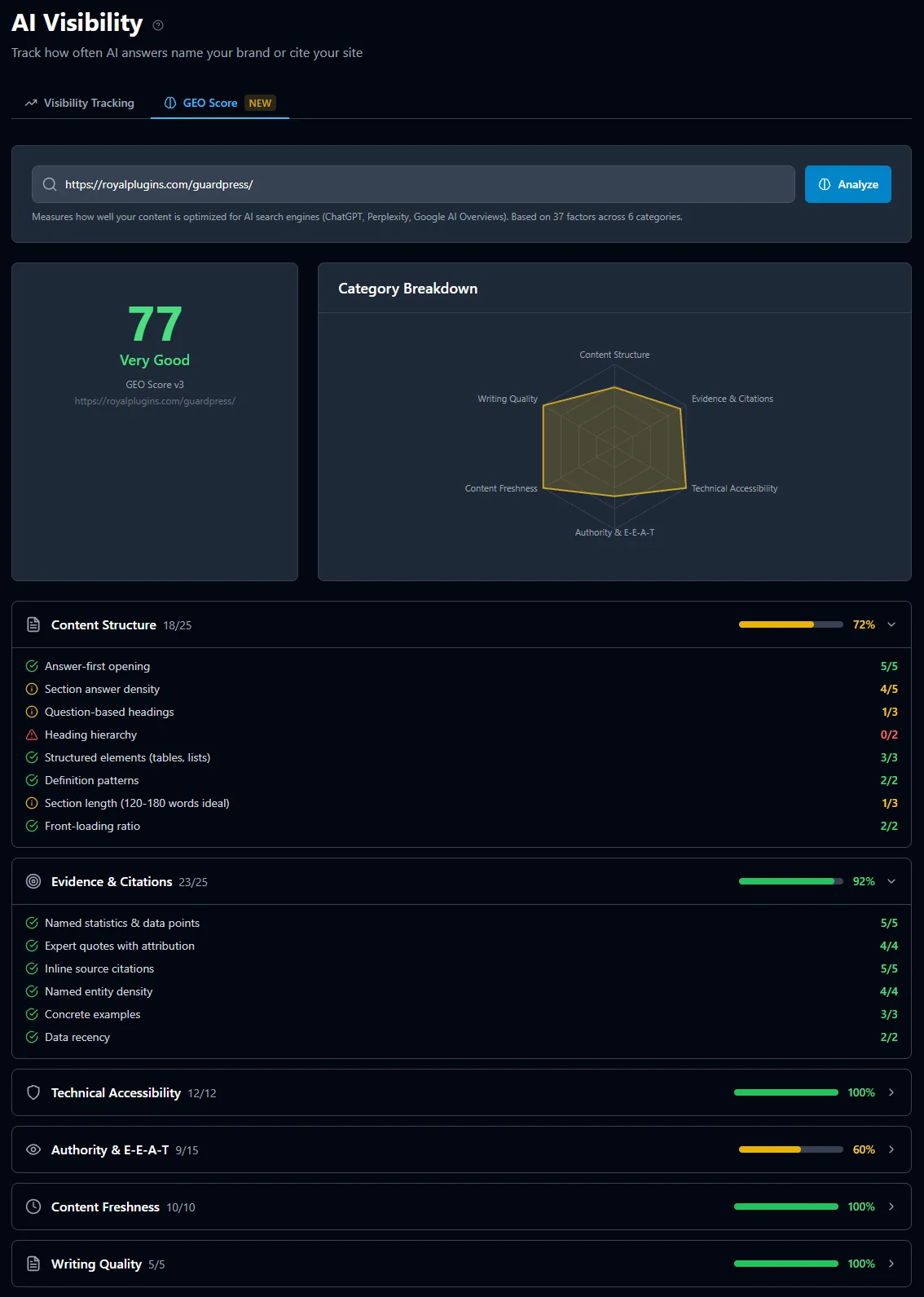
GEO Score measures how well your content is optimized for AI search citations. It analyzes 36 research-backed factors across 7 categories (Content Structure, Evidence & Citations, Technical Accessibility, Authority & E-E-A-T, Content Freshness, Writing Quality, and Off-Site Brand Signals) to tell you exactly how visible your pages are to ChatGPT, Perplexity, Gemini, and Google AI Overviews.
Paste a URL, get a 0–100 score and a prioritized list of fixes: what to restructure, which evidence to add, and which technical barriers keep AI crawlers from reading the page.
SEO alone is no longer enough because AI search engines now generate direct answers instead of linking to blue results, and traditional rankings don't determine which pages get cited. Google AI Overviews now reach over 2 billion monthly users, and ChatGPT has 800 million weekly users. AI answers often cite pages that don't rank in Google's top results, so ranking well doesn't guarantee you get cited.
“For marketers and SEO professionals, this shift means visibility is no longer defined by ranking position alone. While there’s no secret strategy for being selected by AI systems, success starts with content that is fresh, authoritative, structured, and semantically clear.”
— Krishna Madhavan, Principal Product Manager, Microsoft Bing · Optimizing Your Content for Inclusion in AI Search Answers (Microsoft Advertising blog)
Traditional SEO optimizes for Google's blue links. GEO (Generative Engine Optimization) optimizes for the AI engines that are rapidly replacing them. If your content isn't structured for AI extraction, you're invisible to a growing share of searchers. In the Princeton GEO study, adding citations, quotations and statistics produced a 30-40% relative improvement in source visibility (Position-Adjusted Word Count) in generative engine answers (GEO paper, KDD 2024).
SEObolt's GEO Score tells you exactly what to fix, with specific, actionable recommendations backed by peer-reviewed research.
GEO Score measures 36 scored factors across 7 categories: Content Structure, Evidence & Citations, Technical Accessibility, Authority & E-E-A-T, Content Freshness, Writing Quality, and Off-Site Brand Signals. The factors draw on published research (notably the Princeton / Georgia Tech GEO study) and industry studies, listed in the sources below.
Answer-first format, question headings, heading hierarchy, structured elements (tables, lists), section length, and front-loading ratio. AI engines extract content in chunks. Structure determines what gets cited.
8 factors · 25 pointsStatistics, expert quotes, inline source citations, named entity density, concrete examples, data recency, and whether each number sits next to its source. Content with statistics gets 40% more AI visibility. Expert quotes boost visibility by 41%.[1]
7 factors · 25 pointsAI search bot access in robots.txt (checked per bot for this page; blocking training bots like GPTBot isn't penalised), server-side rendering, HTTPS, page speed, and crawl depth. Schema markup has been reported to give a 30-73% citation boost[3], but a 1,885-page controlled test by Ahrefs found no uplift[4], so schema and llms.txt are shown for information and not scored.
5 factors · 12 pointsNamed author, author schema, first-person experience markers, organization signals, and domain trust. 96% of AI Overview citations come from sources with strong E-E-A-T signals.[5]
5 factors · 15 pointsdateModified recency, publish date presence, stale data detection, and update cadence. Content updated within 30 days gets 3.2x more citations from Perplexity, where freshness is 40% of the ranking signal.[6]
4 factors · 10 pointsDeclarative tone, promotional language detection, readability score, and paragraph length. AI engines deprioritize hedging language and marketing-heavy content in favor of confident, factual writing.
4 factors · 5 pointsBranded search demand from your Search Console data, a Wikipedia article about your brand, and YouTube mentions. AI engines are more likely to name brands the rest of the web already talks about.
3 factors · 8 pointsGEO Score works by fetching any URL you enter, running all 36 factor checks in seconds, and returning a score from 0 to 100 with a detailed category breakdown and prioritized recommendations. Ranking alone doesn't guarantee a citation: Ahrefs found only 37.9% of URLs cited in Google AI Overviews also ranked in the top 10 for the same query (Ahrefs). [8]
Your content is well-optimized for AI citations. 3 recommendations to reach Excellent.
GEO Score is built on peer-reviewed academic papers and large-scale industry studies from institutions like Princeton, Georgia Tech, and UC Berkeley, as well as data from Ahrefs, BrightEdge, Semrush, and Moz. For example, the Princeton GEO study (Aggarwal et al., KDD 2024) tested over 10,000 queries across multiple AI engines to validate which content optimizations actually move the needle. These are the findings that shaped the algorithm:
Adding specific statistics and data points to content increases AI search visibility by up to 40%. Named numbers outperform vague claims.
Including attributed expert quotes is the single strongest content optimization for AI visibility, outperforming every other tested strategy.
Pages with inline source citations (links to authoritative external sources) are selected for AI answers at 10.9x the rate of pages without citations.
Almost all AI Overview citations come from sources with demonstrable Experience, Expertise, Authoritativeness, and Trustworthiness signals.
Pages scoring 70+ on GEO quality metrics with 12+ factor hits achieve a 78% citation rate across Google, ChatGPT, and Perplexity simultaneously.
A GEO Score is only useful if it tells you what to do next. Every recommendation is marked high, medium or low priority, so you fix the factors that matter most for AI citation first — usually answer-first openings, missing statistics and sources, and structured data.
“AI systems don’t just scan for keywords; they look for clear meaning, consistent context, and clean formatting. Precise, structured language makes it easier for AI to classify your content as relevant and lift it into answers.”
— Krishna Madhavan, Principal Product Manager, Microsoft Bing · Optimizing Your Content for Inclusion in AI Search Answers (Microsoft Advertising blog)
Most SEO platforms still grade pages on traditional ranking factors, and where they track AI visibility it's usually a paid add-on. SEObolt puts a per-page GEO Score, AI Visibility tracking and on-page SEO analysis in one dashboard on every plan.
| Feature | SEObolt | Semrush | Ahrefs | Moz |
|---|---|---|---|---|
| GEO Score (AI optimization) | ✓ | ✗ | ✗ | ✗ |
| AI Visibility tracking in the base plan | ✓ | ✗ | ✗ | ✗ |
| On-page SEO audit | ✓ | ✓ | ✓ | ✓ |
| Starting price | $29/mo | $140/mo | $129/mo | $99/mo |
Traditional SEO gets you into Google. GEO Score gets your pages ready for ChatGPT, Perplexity, and AI Overviews — and AI Visibility shows you when they start citing you. Start analyzing your content today.
Get Started with SEOboltGEO Score is a scoring system that measures how well your content is optimized for AI search engine citations. It analyzes 36 research-backed factors across 7 categories, including content structure, evidence density, technical access, and authority signals, and returns a score from 0 to 100 with specific recommendations. For example, a page scoring 82 might only need to add expert quotes and fix its heading hierarchy to reach 90+.
Traditional SEO optimizes for Google's organic blue links using keywords, backlinks, and technical factors. GEO (Generative Engine Optimization) optimizes for AI-generated answers in tools like ChatGPT, Perplexity, and Google AI Overviews. While there is overlap, GEO specifically targets the signals AI engines use to select citations (such as answer-first paragraphs, inline source citations, and structured data) that traditional SEO tools like Semrush and Ahrefs don't measure.
They answer different questions. GEO Score grades a page before and after you change it: is it built to be cited by AI? AI Visibility tracking measures the outcome: do AI engines actually name or cite your brand? Both are in the same section of the SEObolt dashboard.
GEO Score is based on peer-reviewed research from Princeton, Georgia Tech, and UC Berkeley, along with large-scale industry studies from BrightEdge, Ahrefs, and Position Digital. The Princeton GEO study alone tested over 10,000 queries across multiple AI engines. We cross-referenced findings from Gartner, Wellows, and the UC Berkeley GEO-16 Framework to ensure comprehensive coverage.
Walk through every factor behind Schema Score, Local SEO Score, and GEO Score, and what to change on your content to move each one.
What llms.txt is, why ChatGPT and Perplexity use it, and how to ship one that GEO Score actually rewards.